TUTORIAL – Composition of a painting, the focal point
This newsletter article relies on my own recent experiences of being tutored, listening to artist friends, attending workshops, trialing ideas, reading books and art magazines and lots of practice of the things I get wrong or don’t do well! Please note I seldom get this right myself but believe that moving forward and experimenting can reap rewards. I am conscious that there are not really any hard and fast rules to follow!
The 5 Elements of a Painting
- SHAPE and STRUCTURE – the skeleton of the painting – the composition – the most essential.
- TONAL VALUES – depth, volume, light. Light and shade work together and need to be different so subjects don’t look flat and there are enough dark values and balance.
- COLOUR CHOICES – evening soft yellows, morning soft whites, choices of colour – do they fit the mood and the subject matter?
- TECHNIQUE – wet on wet, wet on dry, wet washes, dry brush strokes, granulation.
- WOW FACTOR – emotional content, impact!
SHAPE and STRUCTURE – the importance of the focal point in composition
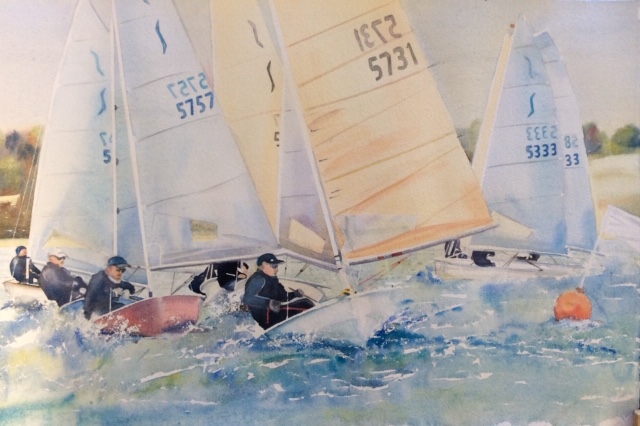
Before starting a painting, a decision needs to be made on the focal point (although this might change during the course of the painting!) to ensure that there is a structure radiating from the focal point so the painting gradually loses contrast and definition away from the focal point. The focal point is at a heightened position with the biggest tonal contrast. As an artist you are forcing onlookers NOT to look away from the main point of the picture. Imagine peripheral vision, blurred and unfocussed on the edges of a painting away from the focal point. There is no point in repeating the precision of this point elsewhere in the painting. Around the periphery there will be lost space, a quiet, resting place, low in colour allowing the painting to breathe and the viewer to interpret.
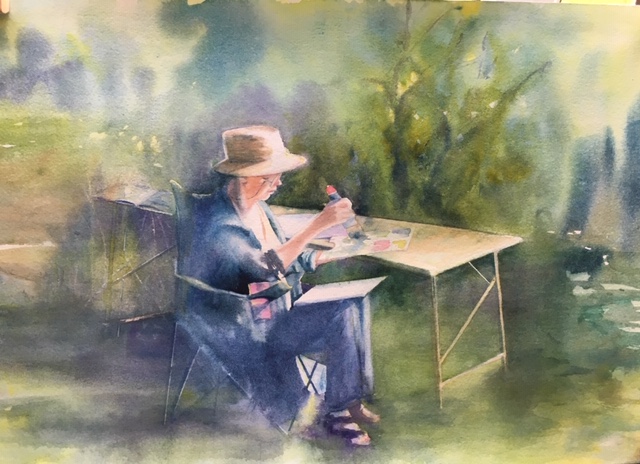
The focal point is usually a small area to attract the eye of the viewer before they look at anything else. Surround this focal point with subtle colours and reduced contrasts. Viewers of large paintings will have a bigger area to view, they need to step back BUT the focal point has to be small and stay small even in a big painting, it may be only 3-4mm. A Focal Point grabs your attention, holds your gaze for at least 10 seconds but can be quite subtle and only slightly more noticeable than the rest of the painting.
If you don’t know what to do with a painting to make it better, put it on a mount board, look hard at the balance, is something missing? The last sentence of a painting, the last full stop is the BIGGEST step. Does the focal point stand out? No? Pop a contrasting colour around it but keep it balanced.
Mel Collins
Note: Mel aims to explore other elements in future articles.